This is not a happy story. It’s just a real story. For 12 years now, I’ve been living in a different country from my parents, my grandparents and my sister. This blog post charts all the trials and tribulations of this International family, and the differences between being single, to being partnered and to now having two young children. I have a couple of “Plan B” style tips to offer – I call them Plan B because they’re never as good as being the same place as your family. Perhaps those readers who are in a happier equilibrium with the long distance can contribute more tips.
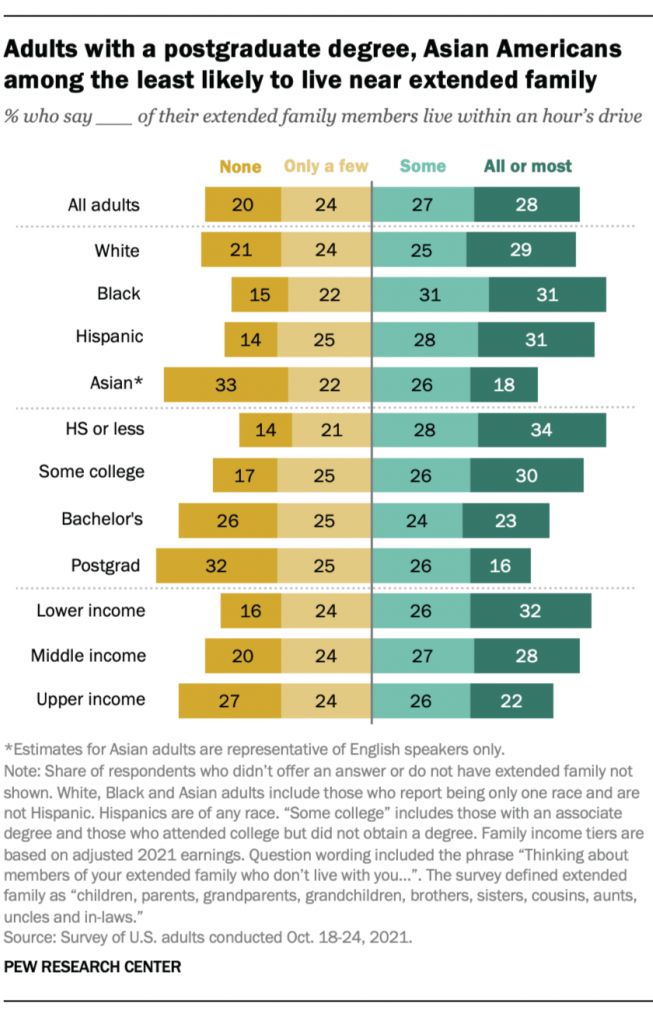
Though I write this intimately about my situation – a Transatlantic family – I think it’ll resonate with people who are domestic but apart: One in five Americans says they do not live near any extended family members at all. And the people least likely to live close to family are those with the highest education levels — only 42% of adults with postgraduate degrees have extended family within an hour’s drive, compared to 56% of those with some college. This places strain on a lot of nuclear families, and the grandparents miss out too. According to AARP, 80% of the nearly 70 million grandparents in the United States say that living near their grandchildren is very important to them — yet over half have at least one grandchild who lives more than 200 miles away.
Single and International
It seemed inconvenient but manageable when I was a single person. I could hop on a flight twice a year to see my family, or take advantage of one of the few flexibilities afforded by my consulting career to find a project in London every now and again. There’s no doubt that extended relocations came at a cost to my career. For example, I moved to London temporarily when my grandmother had cancer and did two projects there that veered me completely off having a coherent story and consistent sponsors in the West Coast. I don’t regret it at all, because I was there for my grandmother in a difficult time for her and the memories of taking her to radiation therapy and just being able to hang out with her are so precious. But I have to be honest: the relocations weren’t costless. I had to put dating on hold for a quarter at a time when I was very ready to meet someone, and I had to give up being selective about projects, simply taking “anything in London”. Flying back and forth felt doable – probably because I was 27, but I think it took a secret toll, a la the Body Keeps the Score theory. Interestingly, sometimes the things we were so immune or exposed to become our biggest allergies later. The 27 year old me flew back and forth every 2 weeks between London and Denver for a two months long project and turned up to work every day for 12 hour days and produced quality work. Now in my mid-30s, my body now protests jet lag from even a 3 hour difference.
If you are in this situation, perhaps even meet your parents or family members on vacation in other locations while you all still have the health and wherewithal to travel!
Partnered and International
Being partnered sets an expectation and a desire for closeness to your partner. For me, when I was partnered and travelling, two weeks apart was painful but doable. Three weeks felt like a stretch, and a month felt like breaking point. I missed my boyfriend (now husband) so much when I went to the UK for three weeks over the winter holidays. I missed spending the holidays with him, our first Christmas together, spent exchanging messages on Signal. These are the kinds of tradeoffs you make constantly with an International family. The popular “you can have it all just not at the same time” adage doesn’t provide much comfort in these situations. A missed Diwali or Christmas or birthday is missed.
I have made attempts to celebrate festivities twice – we celebrated my son’s 2nd birthday twice a week either side of his birthday, with a dinosaur party in the UK and another party in the Bay Area. And I’m glad I did – it was a good Plan B.
Kids and International
This chapter of my life has been so different from the previous ones. TLDR: SO much harder. It’s hard enough being a working parent of a child. Being a working parent who has to work and parent from a different time zone from your colleagues while you and YOUR kid are adjusting to a new time zone is breakdown-inducing level brutal. My lowest points in the parenting journey, by far, have been exactly in this situation: being up at 2 am trying desperately to pacify a crying baby, knowing that tomorrow I have to be online for work, knowing that I don’t have a nanny or daycare like at home, but patchy childcare from ageing and often ailing parents or grandparents or ones that just aren’t used to the grind of providing extended childcare.
I have a new rule that I will not travel whilst working and parenting. The trough in my mental health is not worth it. I also simply don’t have the bandwidth to do it. This rule comes at significant cost:
- My grandmother hasn’t met my 9 month old daughter, quite possibly never will. It’s a great heartache as I know she longs to hold her, and my daughter is growing up so fast she’ll be too heavy and too rambunctious for a frail 90+ year old to hold very soon.
- My parents have missed the majority of my 4 year old’s life milestones. They get Whatsapp updates, but it’s not the same to see a baby walking for the first time in a video than to see them in real life. It becomes clear to me how much they’ve missed when we meet on an annual interval (when they travel here) and I see them having to calibrate to the entirely different child in front of them from when they last saw him. “Oh he says full sentences now!”, “Oh he’s so big now!”. I notice tiny moments of gratitude and smile when they recount a memory that’s long buried in my history now of something my kid did when they were younger. For my parents, it’s the last reference point and fresh in their minds. For me, it’s a sweet trip down memory lane. “Oh, yes he used to say “Bamayaan” for banana when he was two.
- I haven’t been there for my parents’ health problems. The many times they could use someone for moral or logistical support, they have no one to turn to but each other. They get no external, fresh perspective. They get practically no reward for all the hard years of parenting they put in.
- I get all the burden that comes with being in an isolated nuclear family. I’m so deprived of time to myself that I resent my children frequently in the evenings. I envy those friends who can just drop off their kids for an evening to a nearby grandparent, and have a break. As a nuclear family, we get very few breaks. Most breaks are paid for ($30/hour in the Bay Area for 1 kid, $40+ for two!) and tightly scheduled and coordinated with babysitters, who we have to onboard frequently, plan in advance and explain things to. There’s no spontaneity. There’s no break for just hanging about in the house with some peace and quiet, writing a blog post, doing taxes.
I do the same things everyone else with far away family does: weekly video calls, near-daily photo dumps of what’s going on with the kids on the chat group. But it’s really a skill and muscle to be able to keep a level of depth to these brief conversations, made more challenging when some family members have capability issues with technology, or are not just phone people.
Drifting into aquaintances
On top of the day-to-day logistical challenges arising from having no backups (and I know single parents have it SO much worse), there’s a steady process underlying all this that is emotional and relational. Slowly but surely, you are drifting further apart from your family members. You’re knowing them less. You’re in the process of becoming acquaintances, even strangers. You all evolve. You all change, but your mental models of each other stay stuck. Your understanding of each other’s lives reduces each day. They have health problems you don’t know about. Minor accidents and falls you hear about later. Fights and administrative headaches that you only see glimpses of in short visits. I realized how out of touch we were when my parents and I were literally at the same airport once for different flight connections and we only figured that out later, totally missing the opportunity to meet up!
Would I do it again if I could turn back the clock? It’s a hard question to even imagine. With what I knew at the time, the family pressure and encouragement to move to a geography of greater opportunity, and being grateful for my partner and kids, it’s an impossible question to answer and moreover, as Elsa sings in Frozen “The Past is in the Past”. Now being partnered with a partner who has family here and my family there, this is my destiny. I can just write this blog post to give voice to my own frustration, my sadness, my heartbreak. To hold a mirror up to yours possibly.
And to validate those who did a smarter calculus than I did at an earlier age, and chose to move back to their families or to not veer off too far. They knew that whatever opportunities some other land promises, like the shining glittering pull of Silicon Valley, are not going to be able to pay for all that you miss. True wealth is not the equity you have in the tech company, is not accolades on a resume, is not the outward manifestations of “success” that are so disproportionately heavily celebrated in our culture, but the freedom to spend your time with the people that matter most to you.
References
David Brooks Atlantic essay from 2020: “The Nuclear Family Was a Mistake”
AARP Data cited in: https://lathrop.kendal.org/2024/03/01/should-you-move-to-be-near-children-and-grandchildren
An interesting chart from there: